Choosing among the 2026 top Commercial Led Display manufacturers and suppliers requires more than comparing screen prices. A bright cabinet may look impressive in a showroom, yet fail under sunlight, heat, dust, or continuous operation. This guide examines practical evidence, including pixel pitch, brightness, refresh rate, color consistency, thermal design, cabinet durability, warranty terms, and service response.
David Haynes, founder of Sixteen:Nine and a respected digital signage analyst, has stated, “Digital signage is not just a screen; it is a communications medium.” That principle matters. A reliable Commercial Led Display must support clear communication, stable content playback, safe installation, and measurable audience impact. Product specifications alone cannot prove those outcomes. Field projects can.
The manufacturers discussed here are assessed through technical documentation, installation experience, customer support records, certifications, and published case studies. Supplier transparency also matters. Can the company explain its LED package, receiving card, power system, and replacement process? Can it provide consistent modules months later?
No list is perfect.
Regional pricing, production capacity, and service quality can change quickly in 2026. Some companies excel in fine-pitch indoor walls, while others perform better in outdoor stadiums, retail façades, transportation hubs, or rental applications. A supplier with excellent hardware may still offer weak local support. That gap is easy to overlook.
This overview aims to make the comparison practical, balanced, and easier to verify. It highlights proven strengths, possible limitations, and questions buyers should ask before signing a project contract.
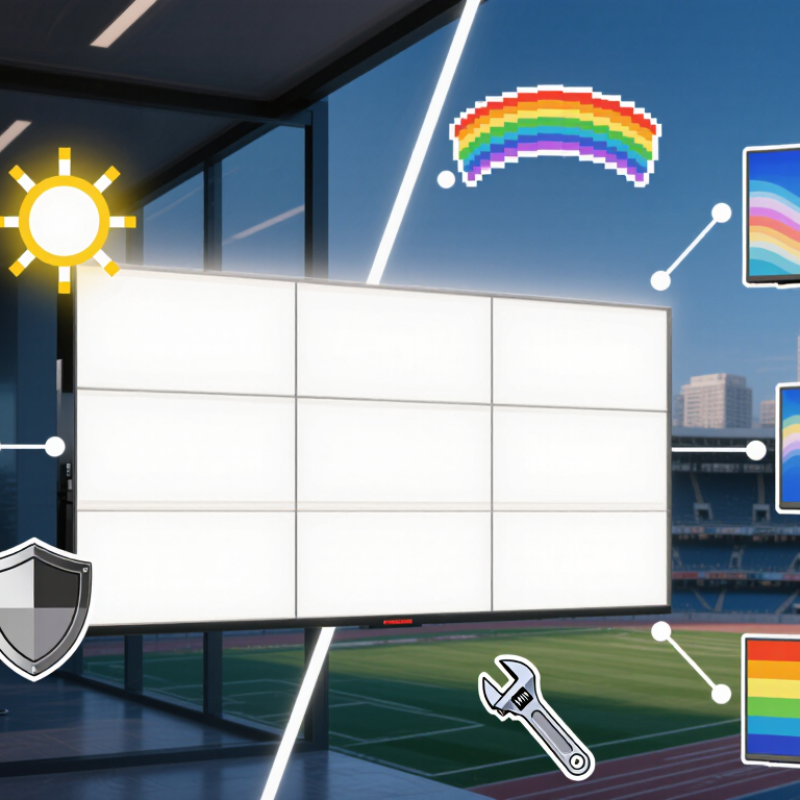
A commercial LED display manufacturer does more than assemble cabinets and ship modules. It designs the display system around brightness, viewing distance, pixel pitch, power use, and installation conditions. Engineers should explain these choices in practical terms. A reliable manufacturer also controls key production steps, including module testing, cabinet alignment, color calibration, and aging tests. Small gaps between cabinets can ruin a large video wall.
Experience matters on site. A capable supplier understands indoor retail screens, outdoor billboards, transport hubs, sports venues, and control rooms. Each environment creates different risks. Heat, moisture, sunlight, dust, and continuous operation demand different protection levels. The supplier should provide measured specifications, installation drawings, wiring plans, and maintenance access details. Photos alone are not enough.
Trust develops through evidence. Ask for test records, product samples, warranty terms, spare-part policies, and documented project references. A professional supplier should identify limits instead of promising perfect performance. That honesty is useful. Even strong products may show brightness variation after long operation, or require recalibration after replacement. This part is often overlooked.
A dependable commercial LED partner also provides technical training and responsive after-sales support. Remote guidance can solve simple faults, but complex failures may require trained technicians and replacement modules. Clear communication about lead times, quality checks, and shipment protection reduces project uncertainty. The best choice is not always the lowest quotation. It is the supplier that can prove consistent quality before, during, and after installation.
Commercial LED display manufacturers and suppliers typically design products for different viewing environments. Indoor fine-pitch displays require lower brightness for comfortable close-range viewing, while outdoor and digital-out-of-home displays require substantially higher brightness to remain visible in direct sunlight.
Commercial LED display systems in 2026 depend on more than pixel density. Fine-pitch SMD modules support close viewing in control rooms and retail spaces. Chip-on-board designs improve surface protection and reduce visible package gaps. However, COB repairs can demand specialized tools and trained technicians.
High refresh rates matter when cameras record large displays. A rate above 3,840 Hz can reduce scan lines and flicker in broadcast footage. HDR processing expands highlight detail, while 10-bit signal handling creates smoother gradients. According to MarketsandMarkets, the global LED display market is projected to reach about USD 20 billion by 2027, driven partly by digital signage and large-format installations. The exact share of commercial systems remains difficult to isolate.
Thermal control is less visible but equally important. Sensors can monitor cabinet temperature, voltage, and module errors in real time. Front-service access also reduces maintenance time in crowded stores or transit halls. The U.S. Department of Energy reports that efficient solid-state lighting can use substantially less energy than traditional lighting technologies, yet an LED wall still consumes significant power at high brightness. This is often overlooked. Content scheduling, automatic brightness control, and calibrated white balance can reduce waste. Standards-based testing, documented installation records, and independent measurements improve reliability, although even a carefully engineered system may show uneven color after years of outdoor exposure.
| Technology or System Type | Typical Pixel Pitch | Typical Brightness | Common Refresh Rate | Protection and Reliability | Key Technologies Used | Typical Commercial Applications |
|---|---|---|---|---|---|---|
| Indoor SMD LED Display | 1.2–4.0 mm | 600–1,500 nits | 1,920–3,840 Hz | Front or rear service; controlled indoor environment; expected service life commonly 80,000–100,000 hours under suitable operating conditions | Surface-mount diodes, constant-current ICs, grayscale processing, automatic brightness control, receiving-card calibration | Retail stores, corporate lobbies, conference rooms, control rooms, broadcast studios |
| Fine-Pitch COB LED Display | 0.7–1.5 mm | 500–1,200 nits | 3,840–7,680 Hz | Encapsulated LED surface offers improved impact, dust, and moisture resistance compared with exposed diode packages | Chip-on-board packaging, common-cathode driving, low-reflection coating, high-density pixel layout, pixel-level calibration | Premium meeting rooms, virtual production, command centers, museums, high-resolution signage |
| GOB-Protected LED Display | 1.5–4.0 mm | 800–2,000 nits | 1,920–3,840 Hz | Glue-on-board encapsulation improves resistance to accidental contact, dust, and localized moisture; protection level depends on construction | Transparent protective encapsulation, SMD modules, modular front maintenance, thermal management, calibration software | Interactive displays, transport halls, education facilities, rental staging, high-traffic public areas |
| Outdoor SMD LED Display | 3.9–10.0 mm | 4,500–8,000 nits | 1,920–3,840 Hz | Typical cabinet protection is IP65 at the front and may be IP54–IP65 at the rear, depending on design and certification | Weather-resistant cabinets, automatic light sensors, conformal protection, high-brightness LEDs, heat dissipation channels | Building façades, roadside advertising, stadium perimeters, outdoor plazas, transit advertising |
| Outdoor DIP LED Display | 8.0–20.0 mm | 5,000–10,000 nits | 960–2,400 Hz | Robust through-hole LED package; weatherproof cabinet designs commonly use sealed module and power-compartment construction | Dual in-line package LEDs, high optical output, sealed modules, redundant power options, surge protection | Long-distance viewing, highways, large billboards, industrial sites, stadium scoreboards |
| Transparent LED Display | 3.9–10.0 mm | 3,000–6,000 nits | 1,920–3,840 Hz | Open-frame structure improves airflow; weather resistance varies significantly by module, enclosure, and installation method | High-transparency LED strips, lightweight aluminum frames, rear ventilation, brightness scheduling, modular installation | Glass façades, shopping centers, airports, showrooms, architectural media installations |
| Rental and Touring LED Display | 2.6–6.25 mm | 1,200–5,000 nits | 3,840–7,680 Hz | Fast-lock cabinets, reinforced corners, replaceable modules, and optional outdoor sealing for temporary installations | Quick-lock cabinet systems, curve-compatible frames, redundant signal paths, 16-bit processing, scan-rate optimization | Concerts, exhibitions, product launches, conferences, television and live-event production |
| All-in-One Commercial LED System | 1.5–4.0 mm indoor; 3.9–6.25 mm outdoor | 600–5,000 nits | 1,920–7,680 Hz | Integrated cabinet, power, control, audio, and monitoring functions; final protection rating depends on the selected model | Integrated sending box, video processor, remote monitoring, HDR support, synchronized audio, front-service modules | Digital signage networks, meeting spaces, retail media, hospitality venues, education and public-information systems |
Note: Specifications are representative commercial ranges rather than universal product specifications. Actual brightness, protection rating, power consumption, viewing distance, refresh rate, and service life vary by cabinet design, LED package, installation environment, operating schedule, and applicable certification requirements.
In 2026, leading commercial LED display manufacturers are judged by more than pixel density. They must combine stable production, accurate color control, and responsive technical support. Experienced suppliers document every stage, from diode selection to cabinet assembly and final inspection.
A reliable factory can provide measured brightness, refresh rate, power use, and viewing distance data. These details help buyers compare performance instead of trusting attractive claims.
Site testing remains essential. A display can look excellent indoors but lose clarity under direct afternoon sunlight.
Strong suppliers offer solutions for retail walls, transport hubs, stadiums, conference rooms, and outdoor advertising structures. Their engineering teams should review load limits, ventilation, maintenance access, and control-system compatibility before recommending a product.
Fine-pitch modules may suit close viewing, while larger pixel pitches can reduce costs in distant-view applications.
Weather protection also matters. Outdoor cabinets need tested sealing, corrosion resistance, and safe thermal management. Certification documents should be current and traceable, not simply printed in a sales brochure.
The best manufacturers support installation training, spare-part planning, remote diagnostics, and clear warranty terms. Ask how quickly a failed module can be replaced. That answer reveals operational maturity.
Still, no supplier is perfect. Quoted lifetime figures may depend on temperature, brightness, and daily operating hours. Buyers should request sample measurements and inspect a running display before signing.
I have found that honest suppliers admit limitations early. That may feel less impressive, but it usually prevents expensive surprises later.
Comparing commercial LED display suppliers requires more than checking pixel pitch and brightness. Grand View Research’s 2024 LED Display Market report estimates strong market growth, but market expansion does not guarantee consistent manufacturing quality. Request factory test records for color uniformity, grayscale performance, refresh rate, thermal control, and cabinet alignment. Ask for a finished-panel demonstration, not only a specification sheet. A bright screen can still show visible seams.
Service quality becomes clear after installation. Require written response times, remote diagnostics, spare-module availability, calibration procedures, and on-site training.
MarketsandMarkets projects continued growth in the LED display sector through 2029, increasing pressure on suppliers to support larger and more complex installations. Check whether the supplier documents firmware updates and maintains replacement parts for several years. Promises are easy.
Certifications should match the installation country and application. Look for evidence related to IEC 62368-1, electromagnetic compatibility standards such as EN 55032 and EN 55035, and IEC 60529 ingress protection ratings where outdoor exposure matters.
ISO 9001 can indicate controlled processes, but it does not prove every display is reliable. Ask for current certificates, test laboratories, certificate numbers, and product-model matches. I have seen buyers treat certification logos as quality proof; that is a weak assumption. Compare warranty exclusions, measured power consumption, brightness tolerance, and acceptance-test procedures in writing.
In 2026, choosing a commercial LED display partner requires more than comparing pixel pitches and prices. Grand View Research valued the global LED display market at approximately USD 8.9 billion in 2023, with continued growth projected through 2030. This expansion attracts new suppliers, but capability varies widely. Ask for completed project evidence, not only polished product images. A reliable partner should assess viewing distance, ambient light, mounting conditions, power capacity, and content requirements before recommending a cabinet.
Request measurable data. Brightness should match the venue, not simply reach the highest advertised number. Check refresh rate, grayscale performance, color consistency, thermal design, ingress protection, and expected maintenance access. The partner should provide test reports, warranty terms, spare-parts availability, and a documented service response time. Independent certification matters, especially for electrical safety and electromagnetic compatibility. A low quotation may appear efficient. It can become expensive when replacement modules arrive slowly.
Tips: Visit an operating installation if possible. Measure brightness during daytime and evening conditions. Ask who performs calibration and repairs. Confirm whether control software, shipping, installation, and future servicing are included. No specification sheet predicts every venue. That is where careful questioning matters. Even experienced buyers can overvalue brightness and undervalue heat management, cabling, and local technical support. A strong partner explains limitations clearly, records assumptions, and accepts reasonable project changes without hiding extra costs.
Fine-pitch modules support close viewing in control rooms, shops, and conference spaces. Larger pitches may cost less for distant audiences. Viewing distance matters most.
A refresh rate above 3,840 Hz can reduce scan lines and flicker in recorded footage. Test the display with actual cameras. Specifications alone can mislead.
HDR preserves more highlight detail. Ten-bit processing creates smoother color gradients. Dark scenes may look more natural. Calibration still matters.
SMD modules support fine-pitch designs and close viewing. COB surfaces offer stronger protection and fewer visible package gaps. COB repairs may need special tools and trained technicians.
Sensors can track cabinet temperature, voltage, and module errors. Good ventilation protects performance. High brightness creates substantial heat and power demand.
Automatic brightness control lowers output during darker periods. Content scheduling avoids unnecessary operation. Calibrated white balance can reduce excess brightness. Energy savings are not automatic.
Request measured brightness, refresh rate, power use, and viewing-distance data. Ask for load limits, ventilation needs, and control compatibility. Inspect a running sample.
Check front-service access, spare-part planning, remote diagnostics, and warranty terms. Ask how quickly a failed module can be replaced. That answer matters.
No. Outdoor cabinets need tested sealing, corrosion resistance, and safe thermal management. Direct afternoon sunlight can reduce clarity. Site testing remains necessary.
Not completely. Lifetime depends on temperature, brightness, and daily operating hours. I would request independent measurements. Even careful systems may develop uneven color over time.
This guide explores what distinguishes a reliable Commercial Led Display manufacturer or supplier in the 2026 market. It explains how professional providers support the full project lifecycle, from product design and customization to installation, maintenance, and technical service. Readers will also learn about key technologies used in commercial LED display systems, including fine-pitch modules, energy-efficient components, high-brightness performance, advanced control systems, seamless integration, and smart monitoring.
The article further outlines practical ways to evaluate leading suppliers without relying only on product price. Important considerations include image quality, durability, manufacturing consistency, certifications, warranty coverage, after-sales support, delivery capability, and experience with similar projects. Finally, it provides a structured approach to selecting the right partner by matching display specifications, application requirements, budget, service expectations, and long-term maintenance needs. This helps businesses make informed decisions and build dependable visual communication solutions for retail, transportation, hospitality, corporate, entertainment, and public environments.