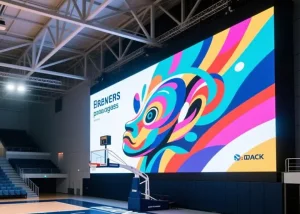
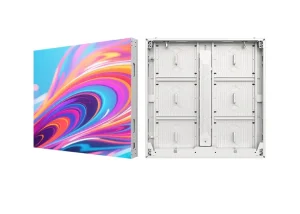
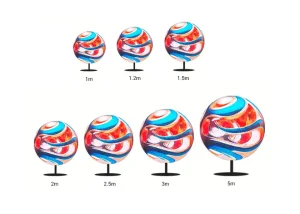
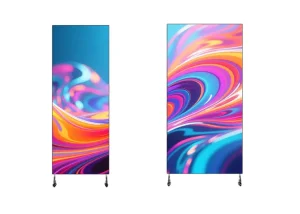
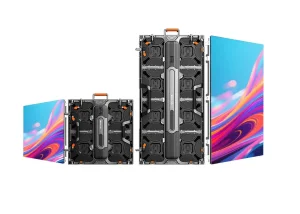
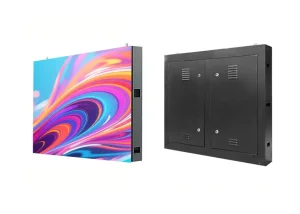
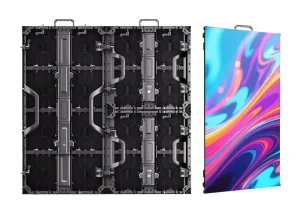
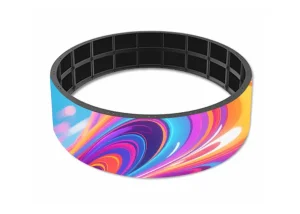
Explore our premier product series manufactured in Shenzhen. Engineered with precision flip-chip packaging, advanced thermal management, and ultra-high dynamic contrast for enterprise deployment.

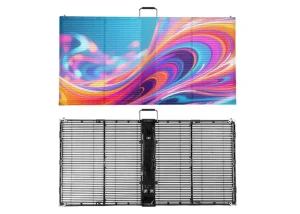
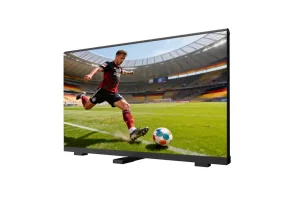
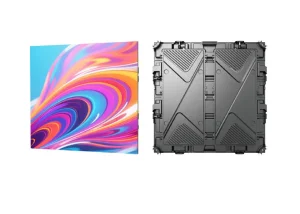
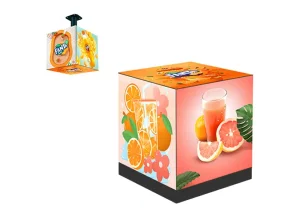
In fine-pitch display engineering, Chip-on-Board (COB) technology represents a fundamental departure from legacy Surface-Mount Device (SMD) encapsulation. As pixel pitches shrink below 1.2mm, classical SMD micro-soldering hits severe physical and reliability limits.
Unlike SMD, where individual RGB LED chips are wire-bonded inside plastic cups and soldered onto PCB pads via SMT reflow, flip-chip COB directly mounts bare semiconductor dies onto the PCB carrier board. The entire array is then vacuum-encapsulated with an optical-grade epoxy resin matrix. This eliminates vulnerable gold wire bonds and mechanical solder joints.
Thermal throttling is the primary cause of LED chromaticity drift and lumen depreciation. COB flip-chip architecture directly connects the P-N junction to the circuit substrate. Eliminating the thermal bottleneck of SMD bracket packages reduces thermal resistance by up to 40%, ensuring lower operational junction temperatures even at peak 1,000+ nit output.
The continuous epoxy surface of COB displays provides an IP65-rated front panel barrier against moisture, dust, static electricity (ESD), and mechanical impact. Cleaning requires only a micro-fiber cloth, contrasting sharply with fragile SMD LEDs that risk pixel dislodgement during physical contact or maintenance.
| Engineering Parameter | Traditional SMD (Surface Mount Device) | GOB (Glue-on-Board Hybrid) | COB Flip-Chip (Chip-on-Board Direct) |
|---|---|---|---|
| Minimum Feasible Pitch | P1.2 mm (Physical limit of package) | P0.9 mm | P0.4 mm - P0.9 mm (Micro-LED standard) |
| Chip Interconnect Method | Gold wire bonding to metal bracket | Gold wire bonding + resin overlay | Wireless Flip-Chip Direct Substrate Mounting |
| Defect / Dead Pixel Rate | 50 - 100 PPM annually | 20 - 30 PPM annually | < 5 PPM (Industry-leading reliability) |
| Surface Hardness & Protection | Fragile (1H), sensitive to moisture/ESD | Medium protection (2H-3H) | High Impact Resistance (4H Hardness), IP65 Front Panel |
| Optical Uniformity & Viewing Angle | 140°/140°, noticeable color shift at off-axis | 150°/150°, moderate optical diffusion | 170°/170° Wide Angle, Continuous Smooth Pixel Surface |
| Power Efficiency & Heat Generation | High power draw, hot surface spots | Moderate heat dissipation | Common Cathode Driving, 30% Lower Surface Operating Temp |
Shenzhen has evolved from a simple assembly hub into the global epicenter of optical packaging research, high-speed automated SMT line integration, and micro-LED semiconductor processing. Navigating this ecosystem requires an understanding of factory capabilities.
Our manufacturing facility operates 100% automated high-speed AS-MP (Advanced Surface-Mount Placement) lines paired with 3D Automated Optical Inspection (AOI) and X-ray void inspection systems. Every batch of COB modules undergoes a continuous 72-hour aging test with high-temperature and high-humidity environmental cycling before shipment.
By establishing long-term strategic partnerships with leading wafer fabs (EpiStar, San'an) and driver IC specialists (Macroblock, Novastar), Chinese tier-1 factories lock in raw material purity, strict binning tolerances, and consistent driver IC wafer allocations even during global semiconductor shortages.
Micro-LED and COB flip-chip assembly requires die-bonding placement accuracies within ±5 micrometers. Industrial automation lines in Shenzhen utilize AI visual calibration to achieve zero-gap module tile alignments, ensuring smooth direct-view video walls without optical seam lines.
Exporting to European and North American enterprise markets demands compliance with electromagnetic compatibility (EMC) Class B, CE, FCC, RoHS, and ETL certifications. Tier-1 manufacturing facilities maintain ISO9001 and ISO14001 certified quality control systems with full batch traceability.
Enterprise buyers across broadcast, government command centers, luxury residential, and digital-out-of-home (DOOH) sectors require tailored COB screen configurations to solve unique environmental and visual constraints.
Critical 24/7 monitoring environments demand zero pixel failure, high greyscale performance at low brightness levels, and seamless canvas scaling. Fine-pitch COB screens (P0.7 - P1.25) eliminate Moiré pattern artifacts, enabling operators to read fine text, GIS maps, and data graphics without visual fatigue.
Film studios and live broadcast environments require ultra-high refresh rates (>7680Hz), high frame rates (120fps+), and wide color gamuts (DCI-P3 >98%). COB display walls with matte anti-glare surfaces eliminate reflection glare from studio lighting rigs while preventing optical camera interference.
High-end retail spaces demand touchable, durable digital signage. Touch-enabled COB poster displays, curved LED pillars, and interactive built-in LED tables utilize COB's 4H surface hardness to survive high-footfall customer interactions while delivering dynamic high-brightness visuals.
Evaluating upfront FOB price tags without considering operational power draw, maintenance downtime, and thermal infrastructure lead to higher 5-year total costs. Procurement teams should evaluate suppliers against structural benchmarks.
| Evaluation Pillar | Technical Audit Checklist Question | Tier-1 Factory Benchmark Requirement |
|---|---|---|
| Driver IC Driving Architecture | Does the system use Common Cathode or Common Anode driving? | Common Cathode (Reduces power draw by 30-40% and keeps operational surface temperature <35°C). |
| Encapsulation Resiliency | What optical film coating technology is applied over the epoxy? | Nano-vacuum coating with anti-glare (AG), anti-fingerprint, and anti-static properties. |
| Calibration Data Memory | Are pixel-level chroma/luma calibration coefficient files stored on module EEPROM? | Module-level auto-calibration backup; replacement modules instantly sync with existing video walls. |
| Mechanical Cabinet Construction | What is the cabinet frame tolerance and material density? | Die-cast aluminum alloy CNC machined with tolerance under ±0.05mm for zero optical seam splicing. |
Comprehensive technical answers provided by our senior display engineers to assist procurement officers and AV system integrators.
Browse our complete range of indoor, outdoor, transparent, rental, and custom-shaped LED display screens available for direct export and OEM deployment.