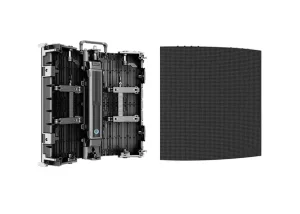
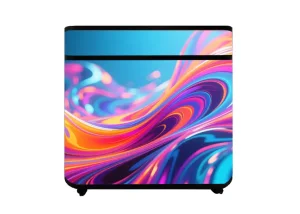
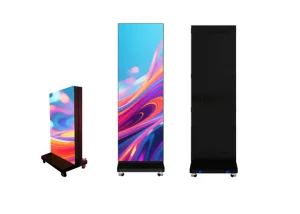
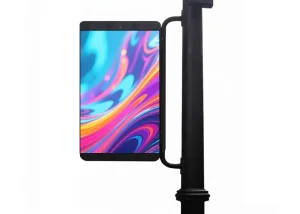
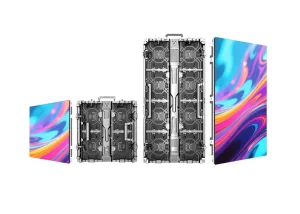
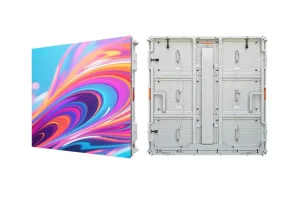
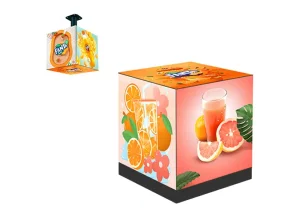
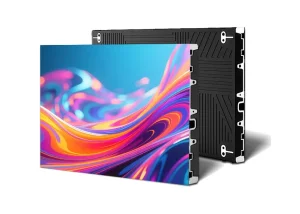
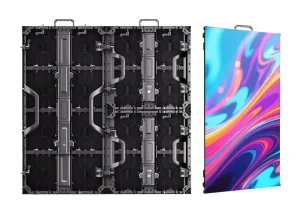
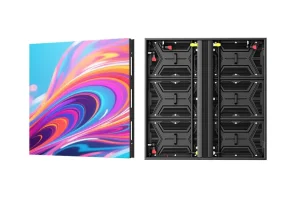
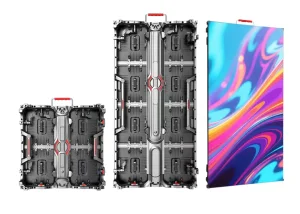
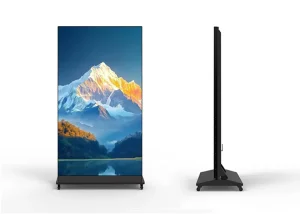
Explore our high-precision engineered indoor fixed, rental, and customized display modules crafted for critical commercial environments.
Selecting between a P2.5 (2.5mm pixel pitch) and P3 (3.0mm pixel pitch) indoor LED screen requires an understanding of semiconductor packaging, optical resolve, human visual acuity thresholds, and thermal dissipation metrics.
When evaluated from a purely semiconductor and optical perspective, the fundamental differentiator between Indoor P2.5 and Indoor P3 LED displays lies in the physical center-to-center distance between adjacent Surface-Mount Device (SMD) LED diodes. P2.5 features a 2.5mm pitch, whereas P3 features a 3.0mm pitch. While a 0.5mm delta appears marginal on paper, it drives a monumental 44% increase in pixel density per square meter.
For system integrators, AV consultants, and commercial architects, this spatial density variance governs content sharpness, optimal viewing distances, maximum viewing angles without Moire interference, driver IC channel loading, and overall thermal output. Below is a definitive engineering baseline matrix comparing custom P2.5 and P3 configurations built by premier OEM manufacturers.
| Technical Parameter | Custom Indoor P2.5 Specifications | Custom Indoor P3 Specifications | Engineering Impact & Notes |
|---|---|---|---|
| Pixel Density (dots/m²) | 160,000 pixels/m² | 111,111 pixels/m² | P2.5 provides 44% more resolution for fine text & HD graphic rendering. |
| SMD LED Package Size | SMD2020 / SMD1515 Black Frame | SMD2121 / SMD2020 High Contrast | P2.5 utilizes smaller emitter packages for optimized pitch spacing. |
| Module Resolution (mm) | 320mm × 160mm (128 × 64 dots) | 192mm × 192mm (64 × 64 dots) or 320×160mm | Standardized 320x160mm modules allow unified cabinet framing. |
| Optimal Viewing Distance | 2.5 meters (8.2 feet) to Infinity | 3.0 meters (9.8 feet) to Infinity | Calculated via Snellen Visual Acuity Formula (1 arcminute resolve). |
| Refresh Rate Capability | 3840Hz – 7680Hz (High PWM Driver) | 1920Hz – 3840Hz (Standard/High PWM) | P2.5 often deployed with high-tier ICs for broadcast compliance. |
| Average Power Consumption | 180W – 240W per m² | 140W – 190W per m² | P3 exhibits lower power draw due to fewer LED diodes per unit area. |
| Max Luminance (Calibrated) | 600 – 1,000 nits (Adjustable) | 800 – 1,200 nits (Adjustable) | Both suit indoor ambient light; P3 offers slightly higher headroom. |
| Structural Cabinet Weight | approx. 7.5 kg / panel (500x500mm) | approx. 7.2 kg / panel (500x500mm) | Die-cast aluminum cabinets provide thermal uniformity for both. |
Evaluating visual performance requires analyzing human visual threshold limits, driver integrated circuit (IC) mechanics, and dynamic contrast ratios.
The mathematical baseline for selecting pitch depends on the viewer's distance from the display. Using the standard visual acuity formula ($D = P \times 1000$, where $D$ is visual acuity distance and $P$ is pixel pitch), a viewer with standard 20/20 vision cannot discern individual pixels on a P2.5 screen beyond 2.5 meters. For a P3 screen, pixel blending occurs at 3.0 meters.
In environments like corporate boardrooms, executive control rooms, or high-end retail boutiques where observers stand within 2 to 4 meters of the video wall, P2.5 delivers a seamless, pixel-free canvas. In large auditoriums or houses of worship where audience seating begins 5+ meters away, P3 delivers perceived 4K quality at a significantly lower capital cost.
Modern indoor video displays are frequently photographed or broadcast live via video conferencing software and TV cameras. Selecting a professional custom manufacturer ensures integration of top-tier PWM Driver ICs (such as Macroblock MBI5153 or Chipone ICN2053).
When operating at 3840Hz to 7680Hz refresh rates with 16-bit grayscale depth, P2.5 and P3 displays eliminate black scanlines, frame flickering, and color banding under high-speed camera shutters. Advanced manufacturers optimize low-gray performance, maintaining true color fidelity even when dimmed to 10% brightness for dark boardroom presentations.
Aligning display characteristics with architectural spaces prevents under-specifying performance or over-spending budget.
Recommended Pitch: Custom Indoor P2.5
In executive conference rooms and NOC (Network Operations Centers), displays render complex schematics, small text data streams, financial spreadsheets, and multi-window 1080p/4K video feeds. P2.5’s 160,000 pixels/m² density guarantees legible text even down to 8pt font size. Combined with ultra-silent fanless power supplies, P2.5 maintains quiet operations essential for executive decision-making environments.
Recommended Pitch: Custom Indoor P2.5 or COB P2.5
High-end fashion outlets, automotive showrooms, and jewelry boutiques require vivid color fidelity (100% NTSC color gamut) and high contrast ratios (5000:1). Close customer proximity (under 2m) makes P2.5 mandatory. Custom black-beaded SMD2020 LEDs enhance deep black levels, turning digital display walls into luxury branding touchpoints.
Recommended Pitch: Custom Indoor P3
Auditoriums, large worship sanctuaries, and university lecture halls present extended viewing distances (5 to 30 meters). A massive 6-meter by 3.5-meter P3 display yields a crisp 2000×1166 physical resolution while yielding substantial cost savings compared to P2.5. These savings can be redirected toward high-end video processors or sound reinforcement equipment.
Leveraging Shenzhen's world-class SMT automation, rigorous quality control, and component integration ecosystem.
Leading Chinese manufacturers operate automated Surface Mount Technology (SMT) cleanroom lines utilizing Yamaha and Panasonic high-speed mounters. Capable of placing up to 100,000 components per hour per line, automated optical inspection (AOI) prevents cold solder joints, short circuits, or misaligned SMD LEDs. This results in module failure rates lower than 0.0001% (less than 1 dead pixel per million).
Quality assurance involves a continuous 72-hour burn-in process. Modules undergo full white balance aging, monochrome red/green/blue stress testing, and thermal chamber cycling (-20°C to +60°C). This process eliminates early component failures before shipping, guaranteeing seamless operation upon global delivery.
By controlling raw material procurement—including Nationstar/Kinglight LED chips, MeanWell power supplies, 4-layer copper PCBs, and Novastar/Colorlight control cards—Shenzhen manufacturers offer factory-direct pricing without distributor markups, supported by comprehensive 3 to 5 year global warranties.
The LED display landscape is rapidly evolving beyond standard SMD packaging into high-durability, energy-efficient architectures.
While conventional P2.5 and P3 displays utilize SMD (Surface Mount Device) soldering, the market is expanding toward COB (Chip-on-Board) encapsulation. COB encapsulates raw LED flip-chips directly onto the PCB substrate under an epoxy resin shield. For indoor P2.5 applications, COB technology delivers IP65 front-face dust/water protection, anti-collision durability, scratch resistance, and wider 170° viewing angles with ultra-low reflection.
Energy efficiency is a key requirement for global procurement. Standard Common Anode circuits supply uniform voltage to Red, Green, and Blue diodes, leading to wasted power as heat. Modern custom P2.5 and P3 displays adopt Common Cathode power architecture, supplying precise voltage directly to individual diodes (2.8V for Red, 3.8V for Green/Blue). This reduces operational temperatures by 10°C to 15°C and cuts power consumption by up to 30%.
Next-generation indoor LED systems integrate AI-powered video processing algorithms. These processors analyze incoming video signals frame-by-frame, applying dynamic contrast optimization, edge sharpening, noise reduction, and SDR-to-HDR10+ conversion. This ensures that P2.5 and P3 LED walls render deep detail, accurate skin tones, and rich contrast even when scaling low-resolution content.
Ensuring smooth international installation through international certifications and complete technical backup.
Commercial displays installed in North America, Europe, and Asia-Pacific must adhere to strict electrical safety and electromagnetic compatibility regulations. Premium OEM manufacturers supply certified displays compliant with CE, FCC Class B, UL62368-1, ETL, RoHS, and IEEE guidelines. Class B EMC compliance prevents radio frequency interference with nearby IT hardware or wireless equipment.
To maintain zero downtime, enterprise orders include a standard 3% to 5% spare parts kit (containing replacement LED modules, receiving cards, power supplies, IC driver boards, and rib ribbons). Additionally, manufacturers support global system integrators through 24/7 remote technical support, CAD structural design assistance, and on-site engineer dispatch for commissioning assistance.
Technical solutions and procurement answers regarding indoor LED pitch selection, installation, and maintenance.
From fine pitch 4K displays to specialized outdoor 3D displays, discover our complete manufacturing portfolio.