Explore our engineering-grade LED display modules directly sourced from our automated SMT fabrication lines.
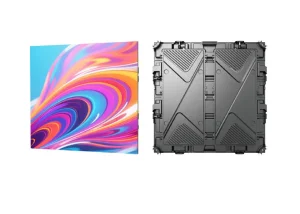
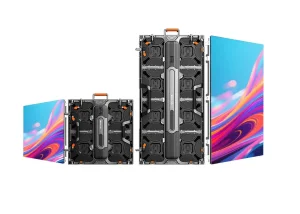
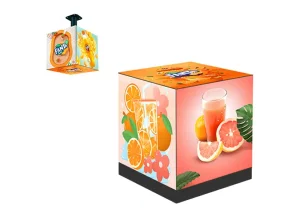
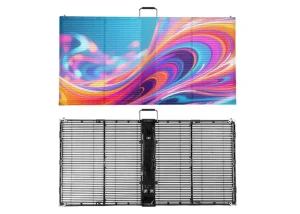
Analyzing search intent, procurement vectors, and technical demands across international B2B display markets.
The global commercial display ecosystem is undergoing a fundamental structural transition. Procurement teams are no longer purchasing passive hardware components; they are commissioning fully integrated visual computing infrastructure. In an era dominated by high-resolution digital-out-of-home (DOOH) advertising, control room telemetry visualization, XR virtual production, and immersive retail architecture, search queries centered around "Custom Led Display Installation Services Supplier & Factories" represent a intent shift from simple transactional buying to high-gain engineering partnerships.
According to recent industrial visual display data, the worldwide market for specialized LED display installation services is projected to expand at a CAGR exceeding 14.2%, reaching over $18.5 Billion USD in enterprise spend. Enterprise buyers—spanning master system integrators, AV rental conglomerates, stadium architects, and smart city infrastructure operators—face unprecedented technical complexity. Purchasing an LED panel is straightforward; however, executing a seamless, mechanically compliant, thermally optimized, and electromagnetically verified (EMC Class B) installation requires deep expertise in both factory-level fabrication and localized structural engineering.
Search intent mining reveals that commercial procurement leaders prioritize five foundational pillars during supplier selection: Sub-millimeter Seamless Alignment, Long-Term Photometric Uniformity, Direct Factory Thermal Management Protocols, Rapid Front-Access Maintenance (Fast-Lock Mechanical Design), and Total Cost of Ownership (TCO) Efficiency. Achieving these benchmarks requires an integrated supply chain that directly bridges Shenzhen automation assembly with worldwide installation support.
How direct OEM/ODM manufacturing ecosystems eliminate intermediaries, enforce quality control, and reduce project lead times.
Operating advanced Fuji and Yamaha high-speed Surface Mount Technology (SMT) lines capable of mounting 0201 micro-components and fine-pitch SMD/COB LEDs with precision tolerances down to ±0.01mm. This automated process minimizes solder bridge defects and optimizes electrical conductivity across multi-layer PCBs.
Every custom module undergoes 72 hours of uninterrupted white-screen continuous aging, thermal cycle stress testing ranging from -40°C to +85°C, and 3D automated optical inspection (AOI). This zero-defect strategy guarantees field reliability before shipment to installation sites.
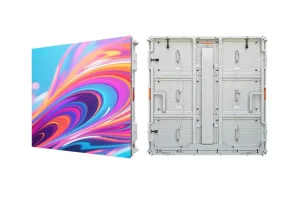
Custom structural cabinets machined using high-precision CNC die-cast aluminum alloys. Providing unmatched structural stability, light total weight, rapid heat dissipation, and seamless cabinet-to-cabinet splicing tolerance under 0.05mm for absolute visual continuity.
Shenzhen, China stands as the undisputed heart of global optoelectronics manufacturing. By housing raw wafer processing, LED encapsulation, driver IC integration, mask injection molding, thermal polyurethane potting, and custom structural aluminum milling within a 30-mile radius, our factories deliver an unmatched speed-to-market advantage. Western engineering integrators partnering directly with Chinese original equipment manufacturers (OEMs) typically realize cost savings between 35% and 50% compared to localized domestic fabricators, without sacrificing component quality or international compliance standards such as CE, UL, ETL, and RoHS.
Tailoring custom LED installation services to specific vertical environments, optical distances, and environmental stresses.
| Application Sector | Pixel Pitch Range | Brightness & IP Rating | Core Technical Requirements | Key Installation Challenge |
|---|---|---|---|---|
| 3D Naked-Eye DOOH Billboards | P3.91 – P10.0 | 6,500 – 10,000 nits / IP65 front & rear | Corner-seamless curve panels, high contrast 5000:1, common cathode energy management | Structural wind-load dynamic resistance & direct sunlight thermal dissipation |
| Broadcast Studios & XR Virtual Stages | P0.93 – P1.95 (COB/GOB) | 800 – 1,500 nits / IP40 indoor | 7680Hz refresh rate, 16-bit color depth, low scan rate, NovaStar/Colorlight processing | Elimination of moiré patterns under broadcast camera zoom lenses |
| Command & Control Operations Centers | P0.93 – P1.56 Fine Pitch | 600 – 1,000 nits / Front access | 24/7 continuous operation, dual-power redundancy, zero-latency signal switching | Extreme pixel-to-pixel flatness alignment across vast multi-panel video walls |
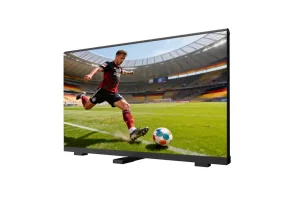
| Sports Arenas & Perimeter Stadiums | P5.0 – P10.0 Soft Mask | 6,000 nits / IP65 weather-proof | Soft rubber impact protection header, quick-turn folding support bracket | Player impact safety mitigation & rapid emergency teardown mechanics |
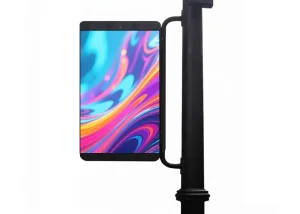
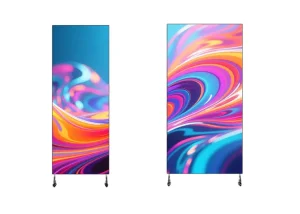
| Smart City 5G Light Pole Displays | P2.5 – P3.33 Digital Signage | 4,500 nits / IP65 waterproof | Integrated IoT telemetry, cluster cloud 4G/5G remote management, light sensor auto-dimming | Vibration damping & power supply stabilization in harsh urban environments |
Engineering custom installations for severe environments requires specialized physical designs. For instance, in high-humidity coastal DOOH billboards, standard conformal coating is insufficient. Our factories utilize double-sided vacuum nano-coating and fully potted module back-shells that seal every IC leg against salt-spray corrosion. Concurrently, for indoor control rooms, the deployment of Chip-on-Board (COB) packaging replaces traditional SMD wires, directly bonding the micro-LED die to the substrate. This lowers diode failure rates to less than 10 PPM (parts per million), while providing a wide 170-degree viewing angle without color shifting.
Empowering B2B buyers with precise calculation methodologies to optimize display spending and technical specifications.
To prevent viewer eye fatigue and avoid pixelated imagery, optical engineers calculate viewing distances based on module pixel pitch ($P$ in mm):
Example: For a P1.56 fine pitch screen, $D_{min} = 1.56\text{ m}$, while optimal visual immersion ($D_{opt}$) is achieved at $3.9\text{ m}$.
Budgeting electrical infrastructure requires calculating Peak Power ($P_{max}$) and Average Operational Power ($P_{avg}$):
Common Cathode architecture separates Red, Green, and Blue power rails (2.8V for R, 3.8V for GB), reducing thermal output by 30-40%.
For outdoor elevated steel frame installations, total dynamic pressure ($W_q$ in $\text{kN/m}^2$) must conform to local wind loading standards:
Where $\rho$ is air density ($1.225\text{ kg/m}^3$), $V$ is maximum gust velocity ($\text{m/s}$), and $C_f$ is the aerodynamic shape coefficient of the cabinet enclosure.
Key technological advancements transforming custom LED display design and enterprise installation services.
As visual display infrastructure evolves, three transformative technologies are reshaping global enterprise procurement standards:
MIP technology decouples micro-LED chip manufacturing from discrete panel mounting. By packaging sub-100μm chips into standardized surface-mount carriers, factories reduce repair costs while delivering black-level contrast ratios exceeding 1,000,000:1 and HDR10+ compliance.
By encapsulating the module surface with an optically transparent epoxy resin, GOB creates an impact-proof, dust-proof, moisture-proof, and anti-static barrier. GOB is becoming the default choice for high-traffic retail posters, rental screens, and touch-interactive video walls.
Next-generation receiving cards integrate embedded AI accelerators that continuously analyze real-time video signal histogram data. The system dynamically scales drive current to individual LED clusters, cutting power consumption during dark scenes by up to 55%.
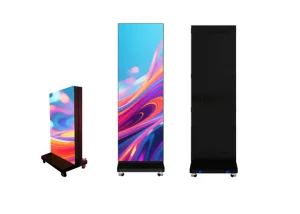
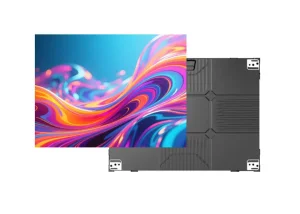
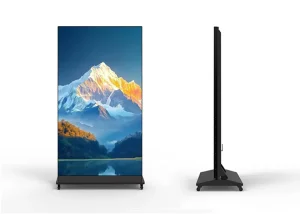
Discover specialized LED configurations engineered for smart cities, commercial retail, stadium events, and custom installations.
Expert answers addressing structural engineering, OEM customization, warranty protocols, and factory logistics.