Direct-from-Factory Engineering Solutions for Smart Cities, High-End Retail & Live Events

Engineering parameters validated through automated optical testing, multi-stage aging thermal cameras, and international B2B deployment audits.
The global optoelectronics landscape is undergoing a structural technological evolution. Direct-view LED (dvLED) systems are expanding beyond traditional out-of-home (DOOH) billboards into sub-millimeter fine-pitch indoor architectural elements, high-definition broadcast environments, extended reality (XR) virtual stages, and mission-critical control rooms. Navigating the current ecosystem requires an intimate technical understanding of chip packaging paradigms, drive architecture, and optical performance specifications.
Historically, Surface Mount Device (SMD) technology—where red, green, and blue LED chips are encapsulated within a plastic casing before being soldered onto a Printed Circuit Board (PCB)—dominated both indoor and outdoor screen manufacturing. However, as enterprise demand pushes pixel pitches below P1.2mm down to P0.4mm, physical limitations inherent to traditional SMD packaging emerge, including thermal throttling, fragile physical solder joints, and limited viewing angles.
Direct flip-chip mounting of microscopic LED dies onto the PCB substrate, sealed with epoxy resin. Eliminates wire bonding, increases structural impact resistance by 10x, drastically improves thermal dissipation, and delivers pitch densities down to P0.6mm.
An interim evolutionary technology for fine-pitch rental and retail screens. standard SMD modules are covered with a high-transparency optical glue layer, achieving IP65 surface waterproof, anti-collision, and anti-static protection.
Unlike legacy Common Anode drives that supply uniform voltage (5V) to RGB chips, Common Cathode technology supplies independent, precise voltage to Red (2.8V) and Green/Blue (3.8V) chips, reducing operational heat by 20°C and power usage by up to 40%.
Simultaneously, the integration of Extended Reality (XR) and Virtual Production (VP) has altered production workflows in cinema and broadcast studios worldwide. Replacing traditional green screens with ultra-high refresh rate (7680Hz), low-latency, dynamic HDR LED walls allows actors to interact in real time with photorealistic 3D backgrounds generated by Unreal Engine. This shift eliminates motion blur, camera moiré artifacts, and costly post-production green spill correction, saving up to 35% in overall film production timelines.
Over 85% of the world's direct-view LED displays are engineered and manufactured in China, with the core industrial cluster centered in the Bao'an District of Shenzhen. This geographical concentration creates an unmatched supply chain velocity, integrating raw component processing, IC drive design, cabinet die-casting, automated SMT surface mounting, and optical calibration within a 30-kilometer radius.
Leading Shenzhen factories operate state-of-the-art Japanese Yamaha and ASM high-speed placement machines capable of mounting over 100,000 components per hour. High accuracy (±0.01mm) is critical for preventing pixel alignment errors in sub-millimeter displays.
Automated Solder Paste Inspection (SPI) prior to chip mounting, coupled with 3D Automated Optical Inspection (AOI) post-reflow soldering, guarantees zero cold solder joints, bridge short circuits, or polarity inversions before potting.
Quality control mandates a continuous 72-hour thermal stress and full-white/RGB step-aging process. Thermal cameras monitor PCB temperatures to eliminate infant mortality of driver ICs and LED packages prior to export.
Sourcing directly from a tier-1 Chinese LED display factory eliminates intermediary markup while securing full technical customization (OEM/ODM). Industrial buyers can specify exact PCB copper thickness (e.g., 2oz to 3oz for enhanced thermal dissipation), driver IC models (e.g., Macroblock, ICN, NovaStar A10s cards), and frame metal alloys (Die-cast magnesium aluminum vs. extruded aluminum vs. zinc-plated steel).
Selecting the optimal LED display infrastructure requires balancing optical requirements against total cost of ownership (TCO). B2B buyers must evaluate physical viewing distance math, thermal dissipation formulas, and refresh rate tolerances to prevent operational bottlenecks.
| Engineering Parameter | Evaluation Formula / Standard | Commercial Benchmark Target | Operational Impact of Miscalculation |
|---|---|---|---|
| Minimum Viewing Distance ($D_{min}$) | $D_{min} (meters) = \text{Pixel Pitch (mm)} \times 1.0$ | P1.2 → 1.2 meters P2.5 → 2.5 meters |
Individual pixels become visible; visual pixelation ruins viewer experience. |
| Optimal Viewing Distance ($D_{opt}$) | $D_{opt} (meters) = \text{Pixel Pitch (mm)} \times 2.5$ | P1.5 → 3.75 meters P3.9 → 9.75 meters |
Ensures seamless color blending and retina-like visual immersion. |
| Refresh Rate Requirements | Visual: ≥ 1920Hz Broadcast/XR: ≥ 3840Hz – 7680Hz |
High refresh drive ICs (e.g., MBI5253/MBI5359) | Flicker, horizontal black scan lines under broadcast/phone cameras. |
| Ingress Protection Rating | Indoor: IP30 – IP40 Outdoor: IP65 Front / IP65 Rear |
Silicone sealing + waterproof cabinet boots | Water ingress causes short circuits, component corrosion, and permanent module burnout. |
| Power Consumption / Heat Output | Max: 600–800 W/m² Avg: 200–300 W/m² |
Common Cathode 4.2V/2.8V dual power supply | Excessive heat causes color shift (blue-ish tint), accelerated LED degradation, high HVAC energy bills. |
A low initial purchase price can hide long-term maintenance costs. Premium manufacturers utilize gold-wire LED encapsulation (capable of enduring high thermal stress) and 4-layer copper PCBs. Lower-cost alternatives often use iron-frame cabinets and copper-wire/silver-wire LEDs, which suffer from rapid luminous decay (up to 30% light output loss within 18 months) and high pixel failure rates. Enterprise procurement specifications must mandate ≥ 100,000 hours to half-brightness (L70) performance and 1:1 spare parts packages (modules, power supplies, receiver cards).
Tailoring optical, mechanical, and signal architectures to localized environmental demands across global commercial and industrial sectors.
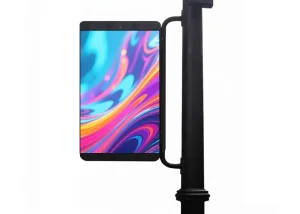
Integrated urban micro-displays mounted on municipal streetlights. Engineered with dual-sided IP65 cabinets, high-bright daylight visibility (7,000 nits), remote 5G IoT cloud content management, environmental sensor telemetry integration, and automated ambient brightness dimming.
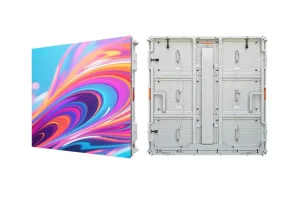
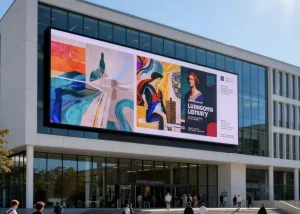
Custom 90° curved or right-angle seamless corner LED cabinets combined with anamorphic 3D video content creation. Uses high contrast ratio (5000:1) modules with aluminum cabinets to deliver vivid depth perception for high-footfall commercial plazas.
Convex/concave curved LED walls featuring ultra-fine pitch (P1.5 - P2.5), 7680Hz refresh rate, 1/8 scan or lower duty cycles, and 16-bit grayscale depth. Integrated with camera tracking systems (e.g., Mo-Sys, OptiTrack) for real-time in-camera visual effects (ICVFX).
Sub-millimeter COB ultra-fine pitch (P0.9 - P1.2) video walls operating 24/7/365. Features redundant hot-swappable power supplies, dual receiver cards for instant failover, silent fanless cooling, and 4K/8K multi-signal processing windows.
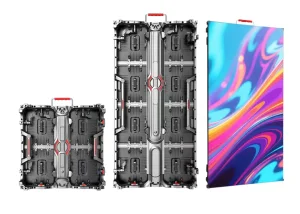
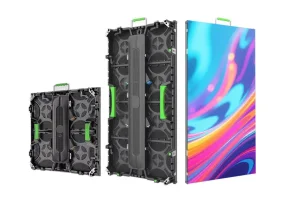
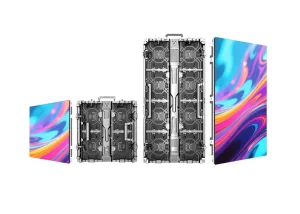
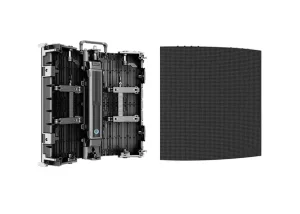
Ultra-lightweight die-cast magnesium alloy panels (500x500mm / 500x1000mm) with fast-locking mechanisms allowing 10-second panel mounting. Features drop-testing corner protection, curving capability (-10° to +10°), and front/rear maintenance access.
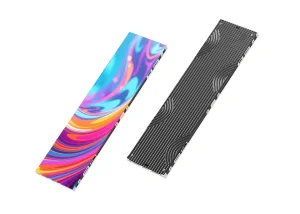
High-transparency (65%–85%) side-emitting LED strips mounted behind storefront glass walls. Preserves natural indoor daylight penetration while turning exterior glass surfaces into high-impact digital advertising canvases.
Transforming complex architectural concepts into certified, operational LED displays requires a structured end-to-end engineering workflow. Modern factory customization spans far beyond basic cabinet dimensional adjustments.
Engineering design of custom cabinet frames, structural load-bearing calculations, finite element analysis (FEA) for wind-load pressure (up to typhoon levels), and CFD thermal airflow modeling for fanless heat dissipation.
Custom PCB layout design prioritizing trace thickness, ground plane isolation to prevent electromagnetic interference (EMI), high-precision surface mounting, conformal coating application, and automated optical inspection (AOI).
Comprehensive 72-hour continuous aging test under elevated thermal stress. Pixel-level brightness and color uniformity calibration (chromaticity correction) via high-resolution optical cameras before shockproof export packaging.
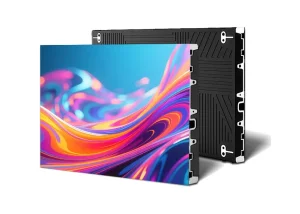
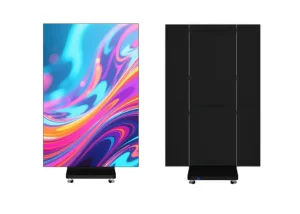
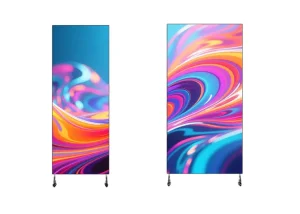
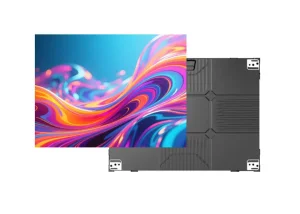
Explore Specialized Modular Displays, Portable Signage & Ultra-Fine COB Video Walls
In-depth technical answers regarding LED display manufacturing, warranties, signal control, and global compliance.