High-refresh rate, fine-pitch, and outdoor heavy-duty displays produced under strict ISO9001 and SMT quality control standards.
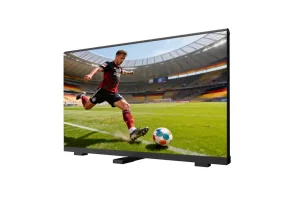
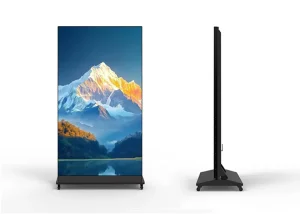
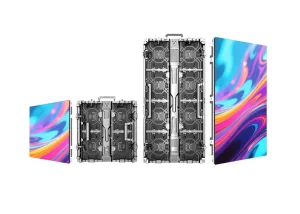
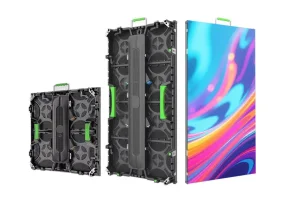
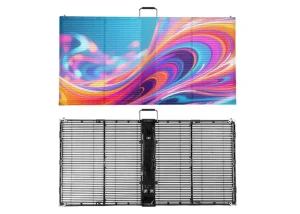
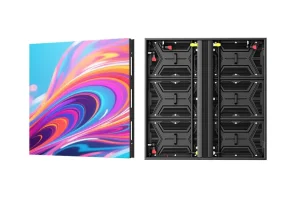
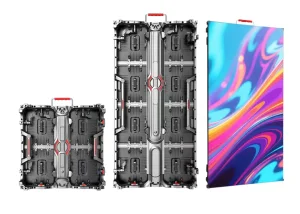
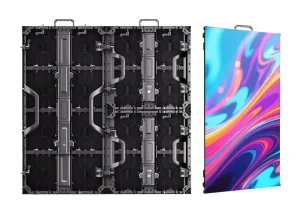
When sourcing wholesale LED displays from Chinese manufacturers, understanding the architectural divergence between Surface Mounted Device (SMD) and Chip-On-Board (COB) technologies is critical for evaluating long-term reliability and optical yield.
SMD Packaging: Employs individual LED chips encapsulated inside plastic brackets (SMD1010, SMD1515, SMD2121), soldered to the PCB via pins. Thermal resistance ($R_{\theta j-c}$) is relatively high due to multiple material interfaces (Diode → Bonding Wire → Bracket Lead → Solder Paste → PCB).
COB Packaging: Directly bonds naked RGB LED chips onto the PCB substrate, encapsulated under a protective epoxy resin flood coating. By eliminating bracket pins, heat paths are shortened by 60%, drastically lowering junction temperature ($T_j$) and reducing thermal degradation rates.
SMD Fragility: SMD diodes are prone to "dead lights" or detachment caused by external physical impacts, mechanical vibrations during rental transport, or moisture intrusion into exposed solder legs.
COB Durability: The monolithic epoxy surface acts as an impenetrable shield. COB panels achieve front-face IP65/IP66 protection natively. They are completely dust-proof, moisture-proof, collision-resistant (can be wiped with a wet cloth), and virtually immune to electrostatic discharge (ESD).
Point Light vs. Area Light: SMD functions as localized point light sources, which can induce eye fatigue during prolonged close-range viewing and produce harsh Moiré patterns in camera-recorded environments.
Surface Light Emission: COB converts point lights into uniform area-surface emission. This delivers smooth, non-glare visual experiences with wide viewing angles ($170^\circ/170^\circ$), making it the gold standard for high-definition conference rooms and virtual broadcast studios.
| Performance Benchmark | SMD (Surface Mounted Device) | COB (Chip-On-Board - Flip Chip) | Winner & Industrial Advantage |
|---|---|---|---|
| Target Pixel Pitch Range | P1.5 – P10.0 (Optimal for >P2.0) | P0.4 – P1.55 (Optimal for Sub-P1.2) | COB for Fine Pitch |
| Diode Failure Rate (PPM) | < 30–50 PPM after 1 year | < 5–10 PPM after 1 year | COB (5x Lower Failure) |
| Surface Protection Level | IP30 (Indoor), Requires Conformal Coating | IP65 Front Face Anti-Collision/Anti-Water | COB Robust Protection |
| Contrast Ratio | 3,000:1 to 5,000:1 | 10,000:1 to 1,000,000:1 (Nano-Black Matrix) | COB Ultra Black |
| Initial Capital Cost (Wholesale CapEx) | Standard Industry Baseline (Low) | 15% – 30% Premium for Sub-1.0mm Pitch | SMD High Cost-Efficiency |
| On-Site Repairability | Easy single-diode replacement via hot-air gun | Requires specialized module-level factory service | SMD Field Repairable |
As global LED screen factories ramp up SMT and COB automation lines in Shenzhen, market dynamics are rapidly shifting toward ultra-high-definition, low-energy configurations.
In North American and European procurement channels, COB fine pitch displays are rapidly replacing legacy LCD video walls in control rooms and corporate boardrooms due to the complete absence of bezels and significantly lower maintenance overhead. Conversely, for high-brightness outdoor DOOH (Digital Out-of-Home) billboards and high-rent event staging, SMD remains the dominant cost-effective workforce due to direct modular serviceability and high lumen density per watt.
How factory automation, Micro-LED wafer transferring, and hybrid packaging technologies like MIP (Micro in Package) are narrowing the cost gap between COB and SMD.
Traditional lead-frame SMD packaging using gold/copper wire bonding. Highly mature supply chain, lowest manufacturing cost, optimal for pixel pitch > P2.0mm. Dominates outdoor fixed, stadium perimeter, and traditional rental markets.
Direct chip-on-board mounting without wire bonds. Flip-Chip COB eliminates physical wire break risk, boosts luminous efficiency, and unlocks ultra-fine pitch down to P0.7. Heavily adopted in premium command centers, luxury home theaters, and studio all-in-one displays.
MIP encapsulates Micro-LED chips into discrete small packages that can be tested, binned, and surface-mounted using standard SMT machinery. This bridge technology combines COB's micro-pitch optics with SMD's yield testing advantages and field repairability.
Sub-50μm RGB LED chips transferred directly to active-matrix glass or silicon backplanes. Achieves infinite contrast, sub-P0.3 resolution, and ultra-low energy draw for transparent screens, wearable displays, and immersive AR environments.
Detailed engineering guidance based on real-world installation conditions, viewing distance, and operational stress factors.
Recommended: COB Technology
When viewing distances are under 2 meters (P0.93 - P1.25), viewers are sensitive to pixel gaps and optical glare. COB’s dark matrix, zero-glare surface, and high MTBF make it ideal for uninterrupted 24/7 operations in security hubs, conference centers, and executive suites.
Recommended: High-Brightness SMD
Outdoor DOOH demands extreme brightness (6,000 to 10,000 nits) to combat direct sunlight. SMD packages (such as SMD2727 or SMD3535) offer superior lumen-per-dollar ratios, proven IP65 waterproofing cabinets, and easy single-diode field repairs without dismounting entire cabinets.
Recommended: Rugged SMD / GOB / COB
Rental panels endure violent transportation and rapid assembly. While high-refresh SMD (7680Hz) remains the primary workhorse, GOB (Glue on Board) treated SMD and COB are gaining traction for ultra-fast setup without fear of dropping tiles or knocking off edge LEDs.
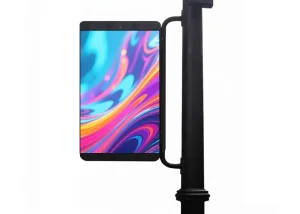
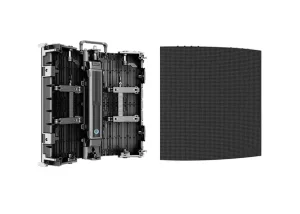
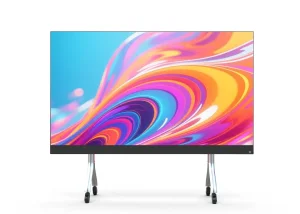
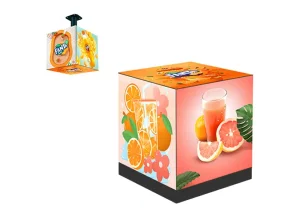
From holographic transparent windows to 5G smart light pole displays, JINGRUNS engineers engineered solutions tailored to your project blueprint.

Direct technical answers engineered for system integrators, AV distributors, and factory procurement directors.