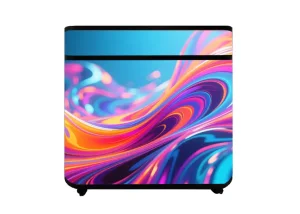
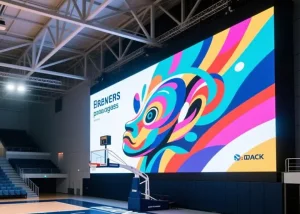
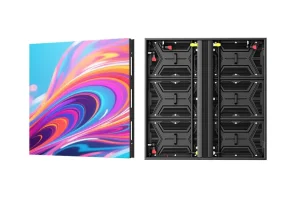
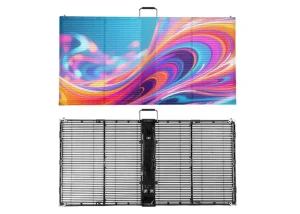
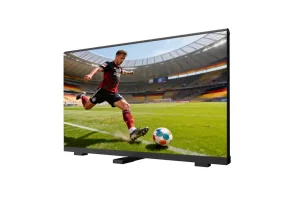
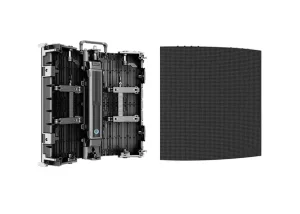
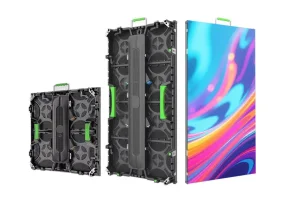
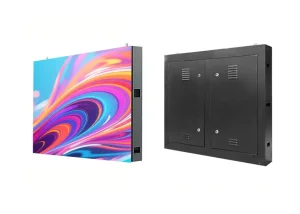
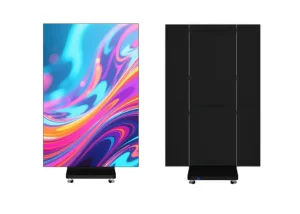
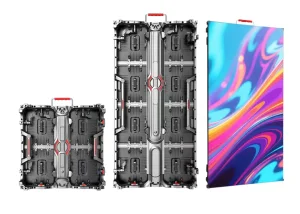
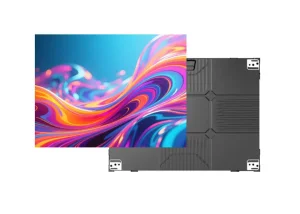
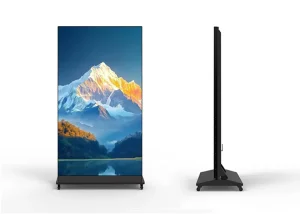
Explore our certified export series engineered for commercial DOOH, dynamic entertainment staging, naked-eye 3D digital billboards, and ultra-high-definition architectural installations.
The global digital out-of-home (DOOH) landscape is undergoing an unprecedented technological renaissance. Driven by rapid urban expansion, smart city infrastructure, and the demand for real-time visual engagement, procurement professionals are looking beyond basic luminance and pixel pitch metrics. Today, evaluating a Wholesale Outdoor LED Display Supplier & Exporter requires a deep understanding of total cost of ownership (TCO), thermal optimization algorithms, structural ingress durability, and optical fidelity under high ambient sunlight.
As high-resolution visual platforms transition from P10 and P8 legacy displays to fine-pitch P2.5, P3.0, and P3.91 outdoor configurations, manufacturing precision must scale exponentially. High-brightness outdoor displays are no longer static billboards; they are integrated digital assets equipped with dynamic programmatic advertising interfaces, automated environmental sensor arrays, and multi-protocol IoT control nodes.
This comprehensive procurement whitepaper outlines the critical technical benchmarks, manufacturing methodologies, macro application frameworks, and supply chain dynamics defining China's position as the global epicenter for outdoor display exporting.
China produces over 85% of the world's LED visual hardware. This market dominance is not merely a result of labor capacity; it stems from a hyper-dense industrial cluster centered in Guangdong's Greater Bay Area (Shenzhen, Dongguan, Huizhou). Within a 50-kilometer radius, top-tier display manufacturers access fully integrated supply chains—from upstream MOCVD epitaxy wafer growth and chip encapsulation (SMD/COB) to midstream multi-layer PCB fabrication and downstream precision die-cast aluminum cabinet tooling.
High-speed Yamaha and Fuji SMT lines achieve mounting accuracies within ±0.01mm. Combined with 3D Automated Optical Inspection (AOI) and Solder Paste Inspection (SPI), defect rates drop below 5 parts per million (PPM), guaranteeing pixel uniformity across multi-thousand-square-meter billboards.
To survive harsh coastal and high-humidity environments, advanced Chinese factories utilize automated robotic conformal coating systems. PCB boards receive dual-layer polyurethane or silicone hydrophobic encapsulation, preventing salt spray corrosion, sulfurization, and condensation short-circuits.
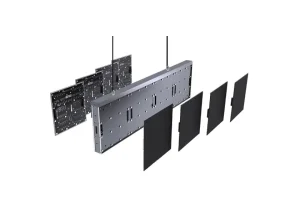
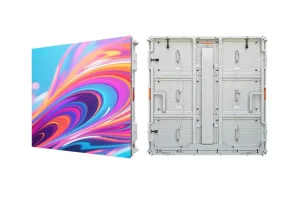
Shifting away from traditional iron sheet metal cabinets, precision high-pressure die-cast aluminum enclosures deliver sub-millimeter seam tolerances, superior passive heat dissipation, a 40% reduction in structural load-bearing requirements, and zero structural rusting over 10+ years of operational life.
The outdoor LED export sector is shifting toward sustainable, high-fidelity visual architectures. Buyers evaluating direct factory suppliers must prioritize three core engineering advancements:
Traditional outdoor display designs utilize a Common Anode drive system, supplying a uniform voltage (typically 5V) to Red, Green, and Blue LED dies. Because Red LEDs require less forward voltage (~2.8V) than Green and Blue (~3.8V), excess voltage on the Red channel converts directly into waste heat. Common Cathode Architecture decouples power lines, supplying dedicated 2.8V to Red and 3.8V to Blue/Green channels. This engineering breakthrough achieves:
Commercial DOOH installations rely heavily on immersive, anamorphic 3D creative assets. Achieving seamless, corner-free visual transition requires custom cabinet engineering featuring 45-degree chamfered edges, sub-0.5mm module alignment tolerances, and specialized high-contrast matte black masks. Paired with high-grayscale driver ICs (16-bit to 22-bit bit depth), these displays eliminate visual distortion lines even under direct daylight conditions.
While Surface Mount Device (SMD) encapsulation remains the workhorse of outdoor displays above P3mm, Chip-on-Board (COB) and Glue-on-Board (GOB) technologies are revolutionizing micro-pitch outdoor screens (P1.25 to P2.5). COB flips microscopic LED chips directly onto PCB substrates, encasing them in a high-grade epoxy resin matrix. This yields an anti-collision, anti-waterproof, anti-dust surface capable of withstanding physical impact, vandalism, and extreme thermal cycling.
Modern outdoor display deployments require holistic hardware and software integration engineered for specific commercial environments. Wholesale suppliers must provide end-to-end macro solutions tailored to unique field conditions:
Engineered for long-distance legibility under intense direct solar radiation. Features automatic ambient luminance sensors adjusting output up to 10,000 nits, heavy-duty structural wind load rating (up to Category 12 typhoons), remote cloud diagnostics via 4G/5G telemetry, and real-time black-screen detection systems.
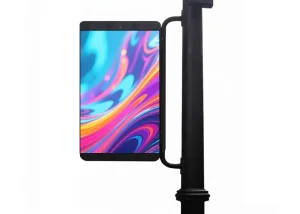
Compact, ultra-thin double-sided displays mounted on urban light infrastructure. Integrates IoT sensors, environmental monitoring (PM2.5, humidity), public Wi-Fi hotspots, surveillance camera mounts, and EV charging interfaces, operating via centralized cloud CMS platforms.
Compliant with FIFA, UEFA, and FIBA regulatory standards. Features soft rubber impact-absorbing masks, protective top cushions to safeguard athletes during collision, dual power-and-signal redundant backup loops, and high refresh rates (7680Hz) to prevent flicker on slow-motion HD broadcast cameras.
High-transparency (up to 75% light transmission) outdoor strip/grid screens designed for curtain wall integration. Preserves natural indoor daylighting, minimizes wind resistance via skeletonized structural designs, and converts office towers into high-yield advertising assets without altering indoor functionality.
International buyers, systemic AV integrators, and engineering contractors must establish rigorous technical qualification frameworks before issuing Purchase Orders (PO) to factory suppliers. The matrix below outlines mandatory technical evaluation standard metrics:
| Parameter Standard | Commercial Standard Benchmark | Premium Industrial Benchmark | Procurement Risk Factor |
|---|---|---|---|
| Ingress Protection (Front / Rear) | IP65 / IP54 | IP68 Fully Encapsulated Modules | Water penetration causing short circuit and IC degradation. |
| Peak Luminance Output | 4,500 – 5,500 Nits | 7,500 – 10,000 Nits (Auto-dimming) | Washed-out imagery under direct noon sun exposure. |
| Refresh Rate & Drive IC | 1,920Hz (Standard IC) | 3,840Hz – 7,680Hz (High-Gray PWM IC) | Scan lines, rolling bands, and camera flicker during events. |
| Power Architecture | Common Anode (5V/5V) | Common Cathode (2.8V/3.8V Dual Drive) | Excessive heat generation, thermal decay, high energy bills. |
| Cabinet Material | Iron / Steel Fabrication | Die-Cast Aluminum Alloy (ADC12) | Cabinet rust, weight burden, structural deformation over time. |
| Service Maintenance Mode | Rear Access Only | Dual-Access (Front & Rear Vacuum Tool) | High scaffolding/rigging costs for simple repairs. |
An authoritative wholesale exporter must maintain rigorous quality assurance protocols to guarantee product stability over a 5 to 10-year lifespan. Buyers should request verified factory test reports confirming the following standard validation procedures:
Modules undergo a minimum of 24 hours of monochrome light-up aging followed by 48 hours of dynamic video aging. High-temperature thermal chamber stress testing forces early component failures at the factory level rather than on the customer site.
Cabinets are subjected to environmental chamber cycling from -40°C to +80°C with 95% relative humidity. This validates module solder joint integrity against PCB expansion and contraction under real-world ambient temperature swings.
Sinusoidal vibration testing simulates international sea and road freight transport. Salt spray corrosion chambers (ASTM B117 standards) verify conformal coatings, stainless steel fasteners, and aviation connectors against marine air degradation.
Global Compliance Standards: Top-tier manufacturing exporters maintain international certifications including CE (EN55032/EN55035 Class B EMC), UL 48 / UL 8750 electrical safety standard approval, FCC Class A/B compliance, RoHS hazardous substance restrictions, and ISO9001:2015 quality system certifications.
Explore our technical portfolio of specialized digital display systems, smart city infrastructure, and fine-pitch indoor visual platforms ready for bulk export shipping.
Detailed responses to critical engineering, logistics, and quality assurance questions raised by international procurement directors and technical contractors.