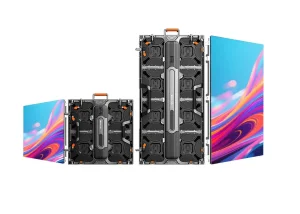
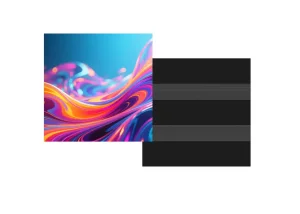
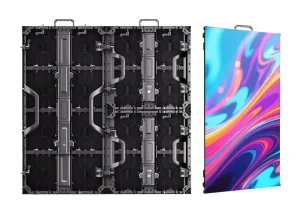
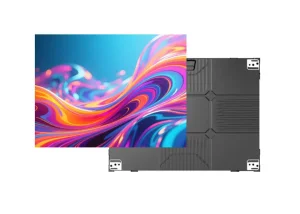
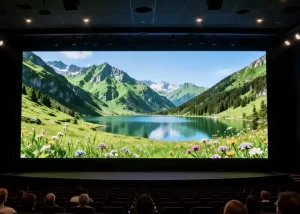
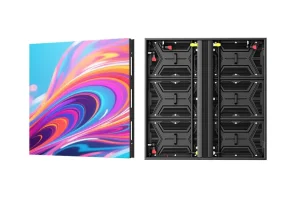
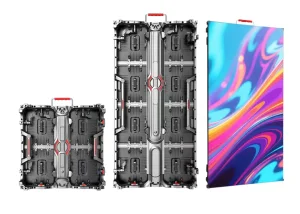
Direct-from-factory modular display hardware optimized for QSR counters, drive-thrus, and architectural hospitality installations.
The transformation of Quick-Service Restaurants (QSRs) and Fast-Casual dining networks through high-gain visual display infrastructure.
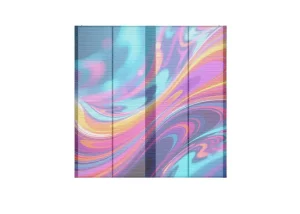
Traditional commercial LCD panels suffer from bezel interruptions, thermal decay, and limited lifespan in continuous 24/7 food prep environments. Modern QSR chains are migrating to seamless Direct-View LED (dvLED) and Chip-on-Board (COB) fine-pitch arrays. This transition eliminates screen grid lines, elevates brightness to bypass high ambient store lighting, and extends operational lifecycle beyond 100,000 hours.
Dynamic menu boards integrated directly into Cloud Point-of-Sale (POS) systems unlock real-time margin optimization. System integrators can deploy programmatic dayparting—automatically altering menu visual weight, highlighting high-margin combos during morning rushes, or hiding sold-out inventory instantaneously to prevent customer friction and speed up throughput.
Over 70% of QSR revenue originates at the drive-thru window. Equipping outdoor lanes with ultra-high brightness (4,500 to 10,000 nits) IP65-rated LED menu systems ensures complete sunlight readability, weather resilience against extreme ambient temperatures, and consistent optical clarity across wide viewing angles.
Quantitative performance indices engineered into our OEM/ODM menu board architectures.
Built for harsh commercial kitchen micro-environments: grease vapor resistance, heat dissipation, and pixel-level color calibration.
Our fine-pitch menu displays leverage Chip-on-Board (COB) technology with Flip-Chip bonding. By removing wire bonds and encapsulating diode dies directly under a protective resin epoxy, screens achieve IP54 front surface protection against airborne cooking oils, moisture condensation, and accidental physical impacts during daily cleaning.
Restaurant digital signage operates up to 24 hours a day. Utilizing Common Cathode driver IC architecture, power is independently routed to Red, Green, and Blue diodes based on exact voltage requirements. This reduces thermal output by up to 35% and lowers operational power consumption ($W/m^2$), reducing corporate Scope 2 carbon footprints and HVAC load.
Downtime in a fast-paced food service establishment leads to immediate revenue drop-off. All menu board modules feature magnetic front-service mechanisms. Service technicians can swap out receiving cards, power units, or individual LED modules in under 60 seconds without dismantling wall-mounting frames or ceiling-hung drop brackets.
| Architecture Feature | Commercial LCD Display | Traditional SMD LED Board | JINGRUNS COB Fine-Pitch LED Menu Board |
|---|---|---|---|
| Bezel Visibility | 1.8mm – 3.5mm Grid Gaps | Seamless Grid | 100% True Seamless Optical Surface |
| Luminance & Contrast | 350 – 700 Nits | 1,200:1 | 800 – 1,500 Nits | 3,000:1 | Up to 4,500+ Nits | 10,000:1 Contrast Ratio |
| Environmental Protection | Unprotected Vents (Dust/Grease ingress) | Conformal Coating (Basic) | IP54/IP65 Moisture, Oleophobic & Dust Nano-Shield |
| Operating Lifespan | 30,000 – 50,000 Hours | 50,000 – 80,000 Hours | 100,000+ Hours to 50% Initial Brightness |
| Thermal Output | High Backlight Heat Accumulation | Standard Common Anode Heat | Common Cathode Ultra-Low Temp Driver ICs |
Custom engineering configurations for diverse retail food, beverage, and quick-service layout topographies.
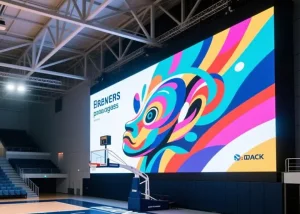
Multi-screen wide-aspect arrays spanning ordering counters. Configured with P1.25 to P1.86 fine pitch modules to maintain ultra-crisp typography even when customers stand less than 1 meter away. Synchronized cloud controllers eliminate frame tearing across wide video walls during promotional video loops.
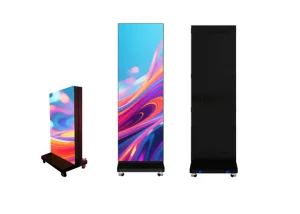
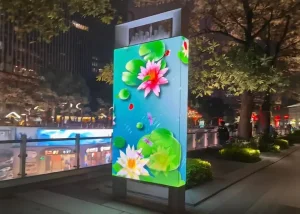
Ruggedized, outdoor-rated IP65 double-sided dynamic displays. Embedded with automatic optical sensors that dim brightness at night to comply with municipal light pollution regulations while boosting luminance up to 10,000 nits under direct midday sun glare.
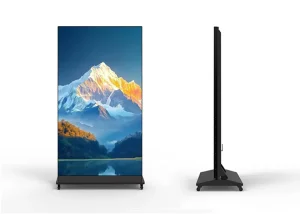
Interactive touch-enabled digital posters and high-impact digital header screens. Interfaced with micro-cameras and customer-queue sensors to automatically adjust font sizes, highlight combo upgrades, or toggle localized multi-language menu displays.
Ensuring complete regulatory alignment across North American, European, and Asia-Pacific commercial installations.
All wholesale units pass rigorous testing for global compliance: CE, FCC Class B, RoHS, ETL, UL 62368-1 (Audio/video, information and communication technology equipment safety standard), and CB certification. Our cabinets feature low smoke, zero halogen (LSZH) internal wiring.
Factory-integrated power distribution systems support universal AC 90V–264V voltage ranges at 50/60Hz, engineered with active Power Factor Correction (PFC > 0.95) to protect electronics against localized grid fluctuations in remote commercial zones.
We provide comprehensive warranty coverage (3-Year Standard to 5-Year Extended) with factory-direct batch matching. To ensure color uniformity across repairs, every production order includes 3%–5% extra module spares from the exact same wafer binning batch.
The next frontier of smart restaurant signage, MicroLED evolution, and automated edge intelligence.
Transition of primary menu lines to P0.9 sub-millimeter pitch MicroLED with black-matrix surface treatment, providing true pitch-black background contrast for luxury dining brands.
System-on-Chip (SoC) receiving cards capable of rendering localized dynamic typography and price changes on screen without relying on external media players.
Integration of self-cleaning silver-ion nano-coatings directly onto COB display faces, actively neutralizing bacteria and grease film in high-temperature food preparation environments.
Next-gen outdoor drive-thru boards featuring ultra-low-power driver ICs linked to localized solar-storage canopy units, enabling net-zero energy menu lane operations.
Expert answers addressing electrical engineering, thermal mitigation, POS integration, and volume manufacturing.
Our COB (Chip-on-Board) displays encapsulate LED dies under a continuous, pinhole-free resin polymer layer. Unlike traditional SMD LEDs with exposed solder joints, airborne oil droplets, steam, and cleaning chemicals cannot penetrate the electrical sub-layer, preventing micro-corrosion and short circuits.
Yes. Our display controllers support cloud-managed media software (such as NovaStar VNNOX, BrightSign, or Android SoC OS) that interfaces directly with POS REST APIs. Price changes or stock updates executed on your POS automatically refresh the menu graphics on screen in real time.
For overhead menus placed 1.5 to 3 meters away from ordering customers, we recommend **P1.25 to P1.86 fine pitch displays**. This ensures sharp text legibility down to 8pt font sizes without individual pixel grid pixelation.
Our cabinets use high-thermal-conductivity die-cast aluminum frames that act as passive heat sinks. Combined with Common Cathode low-power driving chips, temperatures remain below 45°C without needing noisy internal cooling fans that trap kitchen grease.
Standard modular menu display orders ship within 10–15 business days. Custom architectural shapes, curved modules, or client-branded metal enclosures typically require 20–25 days from final CAD engineering approval.
We perform rigorous single-bin wafer sorting prior to encapsulation. Additionally, precise factory color/brightness calibration data is stored in the EEPROM of each individual module, allowing newly swapped spare modules to auto-calibrate to the main wall's exact optical specs.
Explore our complete range of specialized LED products engineered for indoor advertising, outdoor billboards, and high-resolution venue installations.